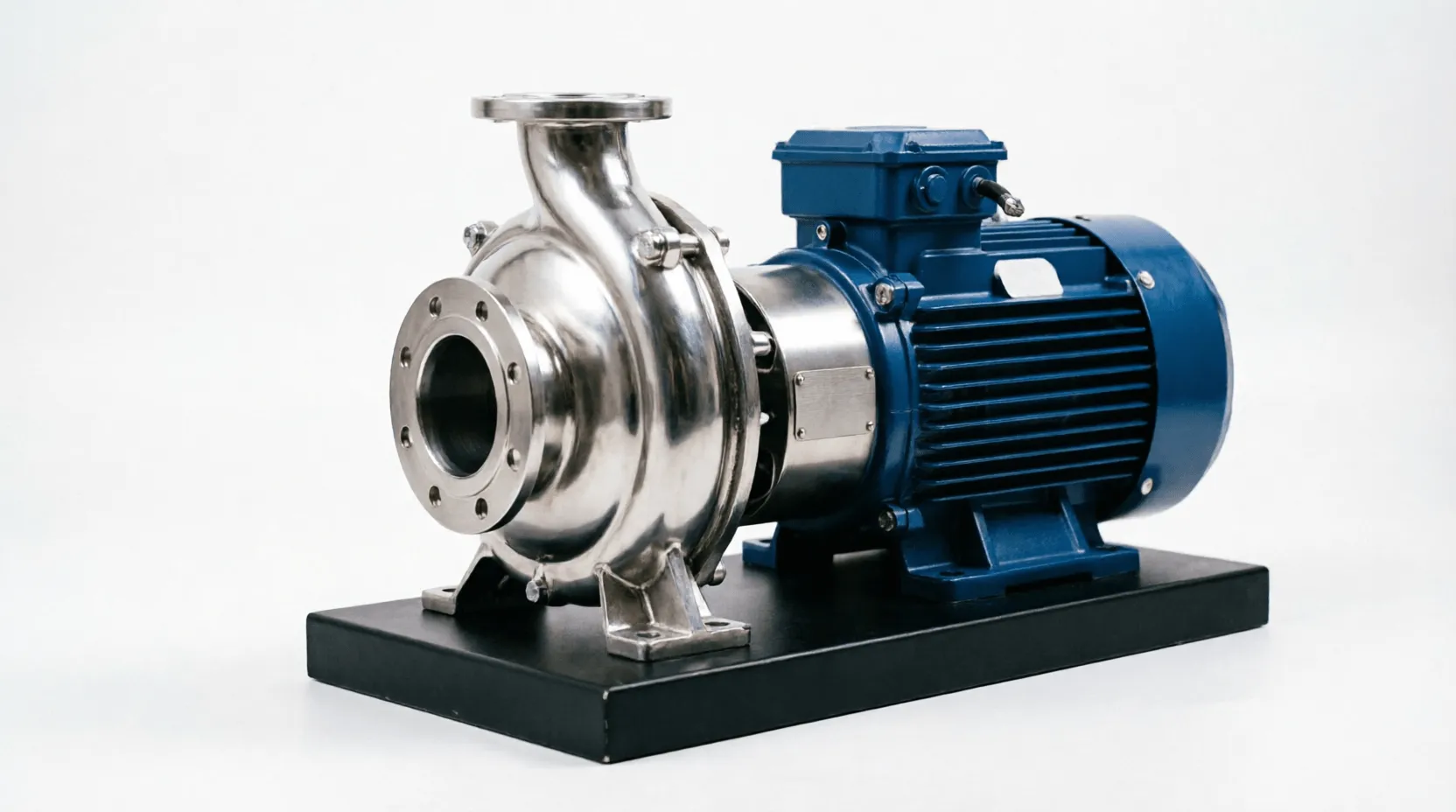



What Exactly Is a Centrifugal Pump?
Imagine standing at the edge of a calm lake and throwing a stone into the water. Watch the ripples spread outward in perfect circles. Now imagine if you could harness that spreading motion — that gentle, continuous push — and use it to move millions of liters of water every day. That, in essence, is what a centrifugal pump does.
At its core, a centrifugal pump is a marvel of simplicity. A spinning wheel called an impeller sits inside a specially shaped housing. When the impeller rotates, it flings water outward using the same physical principle that keeps water inside a spinning bucket — centrifugal force. As water is thrown to the outer edges of the housing, new water rushes in to fill the center, creating a continuous flow.
The TS Series takes this centuries-old concept and refines it with modern materials science, precision engineering, and an understanding that different industries need different solutions.
Why Stainless Steel Matters: The Chemistry of Clean Water
Walk into any modern brewery, pharmaceutical factory, or semiconductor cleanroom, and you’ll notice something immediately: everything gleams. Not for aesthetics, but for survival.
Ordinary cast iron pumps are perfectly adequate for moving irrigation water through farmland or circulating heating water through a building. But introduce them to acidic cleaning solutions, chlorinated pool water, or the ultra-pure water used to rinse silicon wafers, and they begin to dissolve — literally. Iron oxide particles flake off, contaminating the very fluid the pump is supposed to move.
Stainless steel changes the equation entirely.
The secret lies in chromium. When stainless steel contains at least 10.5% chromium, something remarkable happens: the surface forms an invisible, self-healing layer of chromium oxide just a few atoms thick. Scratch the surface, and this layer reforms within seconds in the presence of oxygen. It’s like the metal has its own immune system.
For the TS Series, this means:
- No rust particles contaminating your drinking water supply
- No corrosion pits that grow into leaks and catastrophic failures
- No metallic taste in food and beverage products
- No degradation of ultra-pure water used in electronics manufacturing
The difference isn’t subtle — it’s the difference between a pump that lasts 3 years and one that lasts 20.
The Physics of Pump Curves: Why Your Pump Choice Matters
Every pump has a personality. Some are sprinters — high flow, low pressure. Others are weightlifters — modest flow, tremendous pressure. Understanding this personality is the key to matching a pump to its job.
The Affinity Laws: Nature’s Scaling Rules
If you ever wondered why engineers get excited about variable frequency drives (VFDs), the answer lies in three deceptively simple equations called the Affinity Laws:
Q2=Q1×n1n2
H2=H1×(n1n2)2
P2=P1×(n1n2)3
Let’s translate this from math to meaning.
Flow (Q ) scales linearly with speed. Slow the pump to half speed, and you get half the flow. Straightforward enough.
Head (H ) — the pump’s ability to push water uphill — scales with the square of speed. Half speed means one-quarter the pressure. This is why a pump that struggles to reach the top floor at full speed will fail completely if underpowered.
Power (P ) scales with the cube of speed. This is where engineers see dollar signs. Run your pump at 80% speed, and power consumption drops to 51.2% of full-load value. Run it at 70% speed, and you’re using only 34.3% of the energy.
In a building HVAC system that doesn’t need full cooling capacity 60% of the year, this cubic relationship translates to thousands of dollars in annual electricity savings. The TS Series, with its compatibility with modern VFD systems, turns this physics lesson into real-world efficiency.
A Day in the Life: Where TS Pumps Actually Work
6:00 AM — The Brewery
Before the first shift arrives, the TS pump in the brewhouse has already circulated 50,000 liters of water through the heat exchanger. Last night’s caustic cleaning cycle — pH 13 sodium hydroxide solution — would have destroyed a cast iron pump in months. The stainless steel TS pump shrugs it off. Its impeller spins at 2,900 RPM, moving water at precisely 25 cubic meters per hour, maintaining the 3.2 bar pressure needed for the spray balls to reach every corner of the fermentation tanks.
9:30 AM — The Pharmaceutical Cleanroom
In a Class 100 cleanroom, technicians in full bunny suits monitor the production of injectable medications. The water here isn’t just clean — it’s been through reverse osmosis, deionization, and ultraviolet sterilization. Any metallic contamination at the parts-per-billion level could render an entire batch unusable.
The TS pump circulating this Water for Injection (WFI) has never introduced a single iron ion into the system. Its 316 stainless steel construction (an upgrade from standard 304) resists even the trace chlorides present in the ultra-pure water. The pump’s mechanical seal, a precision-mated pair of silicon carbide faces running at microscopic clearances, has operated for 18,000 hours without a single drip.
2:00 PM — The Semiconductor Fab
Inside a facility where a single speck of dust can destroy a $50,000 silicon wafer, the water is almost too pure to believe. At 18.2 megohm-cm resistivity, this water is theoretically capable of dissolving trace metals from any surface it contacts.
The TS pump here isn’t just stainless steel — it’s been electropolished, a process that removes surface irregularities at the microscopic level, creating a surface smoother than a mirror. Bacteria can’t find purchase. Ions can’t accumulate. The pump becomes invisible to the process, which is exactly what you want when making microchips with features measured in nanometers.
8:00 PM — The Hotel
On the roof of a 30-story hotel, three TS pumps work in parallel, maintaining constant pressure in the building’s domestic water system. When a guest on the 28th floor turns on a shower, the pressure drop is detected in milliseconds. A VFD ramps one pump from 60% to 85% speed. The cubic power relationship means this 42% flow increase requires only 61% of the power that constant-speed operation would demand.
The pumps run quietly enough that guests on the top floor never know they exist. The stainless steel construction means no rust stains in the luxury suites’ marble bathrooms. And when the maintenance engineer checks the system at midnight, the bearing temperature — monitored by a simple infrared thermometer — reads 42°C, well within the safe operating envelope.
The NPSH Mystery: Why Pumps Sometimes “Cough”
Have you ever opened a warm soda bottle and watched bubbles explode from the liquid? Those bubbles are dissolved carbon dioxide coming out of solution because the pressure dropped. Water does the same thing with dissolved air — and when it happens inside a pump, the results range from annoying to catastrophic.
Net Positive Suction Head (NPSH) is the engineering answer to this problem. Think of it as the pump’s “breathing room.”
NPSHa=ρgPinlet−Pvapor+Hstatic−Hfriction
In plain language: the water entering the pump must be under enough pressure that it doesn’t flash into vapor when the impeller accelerates it. If NPSHa (available) drops below NPSHr (required by the pump), bubbles form at the impeller eye. When these bubbles collapse in the high-pressure zone downstream, they create microscopic shock waves that pit the impeller surface — a phenomenon called cavitation that sounds like gravel in the pump and destroys efficiency within weeks.
The TS Series addresses this through careful hydraulic design:
- Larger impeller eye areas reduce inlet velocity
- Smooth inlet passages minimize flow separation
- Low NPSH_r values (as low as 2.0 meters for small models) expand installation flexibility
In a real installation, this means a TS pump can operate successfully with less submergence, longer suction lines, or higher fluid temperatures than competing designs.
Temperature Extremes: From Freezing Winters to Boiling Processes
Water behaves strangely as it approaches its boiling point. At 80°C, its vapor pressure is nearly half of atmospheric pressure. At 95°C, it’s almost equal to atmospheric pressure — which is why water boils at lower temperatures at high altitude.
For pumps, this creates a narrow operating window. The TS Series standard range handles -20°C to +100°C, but the engineering considerations differ dramatically across this span.
Cold side (-20°C to +10°C):
- Water density increases slightly (reaching maximum at 4°C)
- Viscosity increases, requiring marginally more power
- Ice formation risk in standby pumps requires drain-down procedures
Hot side (+60°C to +100°C):
- Vapor pressure rises exponentially
- NPSH requirements increase dramatically
- Mechanical seal elastomers (NBR standard, Viton optional) must be selected for thermal stability
- Motor cooling becomes critical as ambient air temperature approaches fluid temperature
The TS Series handles this range through material selection rather than fundamental design changes — a testament to the robustness of its hydraulic architecture.
The Mathematics of Parallel Operation: When Two Pumps Aren’t Twice as Good
Facility managers often assume that installing two identical pumps doubles the flow. The reality is more nuanced.
When two pumps operate in parallel, their flows add at constant head:
Qtotal=Q1+Q2(at identical head)
But here’s the catch: the system curve — the relationship between flow and head loss in the piping — isn’t linear. Head loss scales with the square of flow:
Hsystem=K×Q2
So doubling the flow quadruples the system resistance. The operating point shifts up the pump curve, meaning each pump produces less flow than it would operating alone. Two pumps in parallel typically deliver 1.6–1.8 times the flow of a single pump, not 2.0 times.
This isn’t a flaw — it’s physics. And understanding it prevents the disappointment of installing redundant capacity that doesn’t quite materialize.
The TS Series, with its stable head-flow curves and non-overloading power characteristics, is particularly well-suited to parallel installations. The pumps share load gracefully, and the system can continue operating — albeit at reduced capacity — if one pump requires maintenance.
Maintenance Philosophy: Prevention vs. Reaction
The best pump maintenance is the kind you never notice. The TS Series enables this through several design features:
Mechanical seals are the only wearing parts that contact both rotating and stationary components. A typical carbon-vs-silicon-carbide seal in clean water service lasts 8,000–12,000 hours. At continuous operation, that’s 1–1.5 years. But in intermittent service — a pump that runs 8 hours daily — the same seal might last 4–5 years because thermal cycling, not wear, is the primary aging mechanism.
Bearing life follows the ISO 281 L10 calculation:
L10=(PC)3×60×n106
Where C is the bearing’s dynamic load rating and P is the actual load. For TS Series pumps operating near their Best Efficiency Point, bearing lives exceeding 50,000 hours are typical — nearly 6 years of continuous operation.
The practical implication: a well-selected, properly installed TS pump in light industrial service might require only annual inspection and seal replacement every 3–5 years. The stainless steel construction eliminates the corrosion-related maintenance that consumes so much attention with cast iron pumps.
The Future of Pumping: Intelligence Meets Hydraulics
The TS Series represents a transitional generation — a pump designed for the analog world but fully compatible with the digital one.
Modern installations increasingly incorporate:
- Vibration sensors that detect bearing degradation weeks before failure
- Temperature monitoring that identifies seal problems from thermal signatures
- Power analyzers that recognize impeller wear from current draw patterns
- Pressure transducers that enable closed-loop flow control without flowmeters
These aren’t features built into the pump — they’re layers of intelligence wrapped around a fundamentally sound hydraulic machine. The TS Series, with its stable operating characteristics and predictable performance curves, provides an ideal platform for this instrumentation.
A pump that “knows” it’s developing a problem and schedules its own maintenance before failure occurs isn’t science fiction — it’s the current state of the art in critical applications. And it starts with choosing a pump whose behavior is consistent enough to establish reliable baselines.
Conclusion: The Invisible Infrastructure
We don’t think about pumps the way we think about bridges or power plants. They’re buried in basements, hidden behind panels, submerged in wells. Yet without them, civilization as we know it would grind to a halt within days.
The TS Series doesn’t seek attention. It seeks reliability — the quiet confidence of a machine that performs exactly as designed, year after year, in environments that would quickly destroy lesser equipment. Whether it’s maintaining pressure in a skyscraper, circulating WFI in a pharmaceutical plant, or transferring process water in a chemical facility, the fundamental physics remain the same: a spinning impeller, a carefully shaped housing, and the elegant transfer of energy from electrons to fluid motion.
Understanding how this works — the centrifugal force, the affinity laws, the NPSH calculations, the material science — doesn’t just make you a better specifier. It makes you appreciate the invisible infrastructure that keeps our modern world flowing.
This article is intended for educational and informational purposes. For specific application engineering, pump selection, and installation guidance, consult qualified pump professionals and refer to manufacturer-certified performance curves.
No comments yet