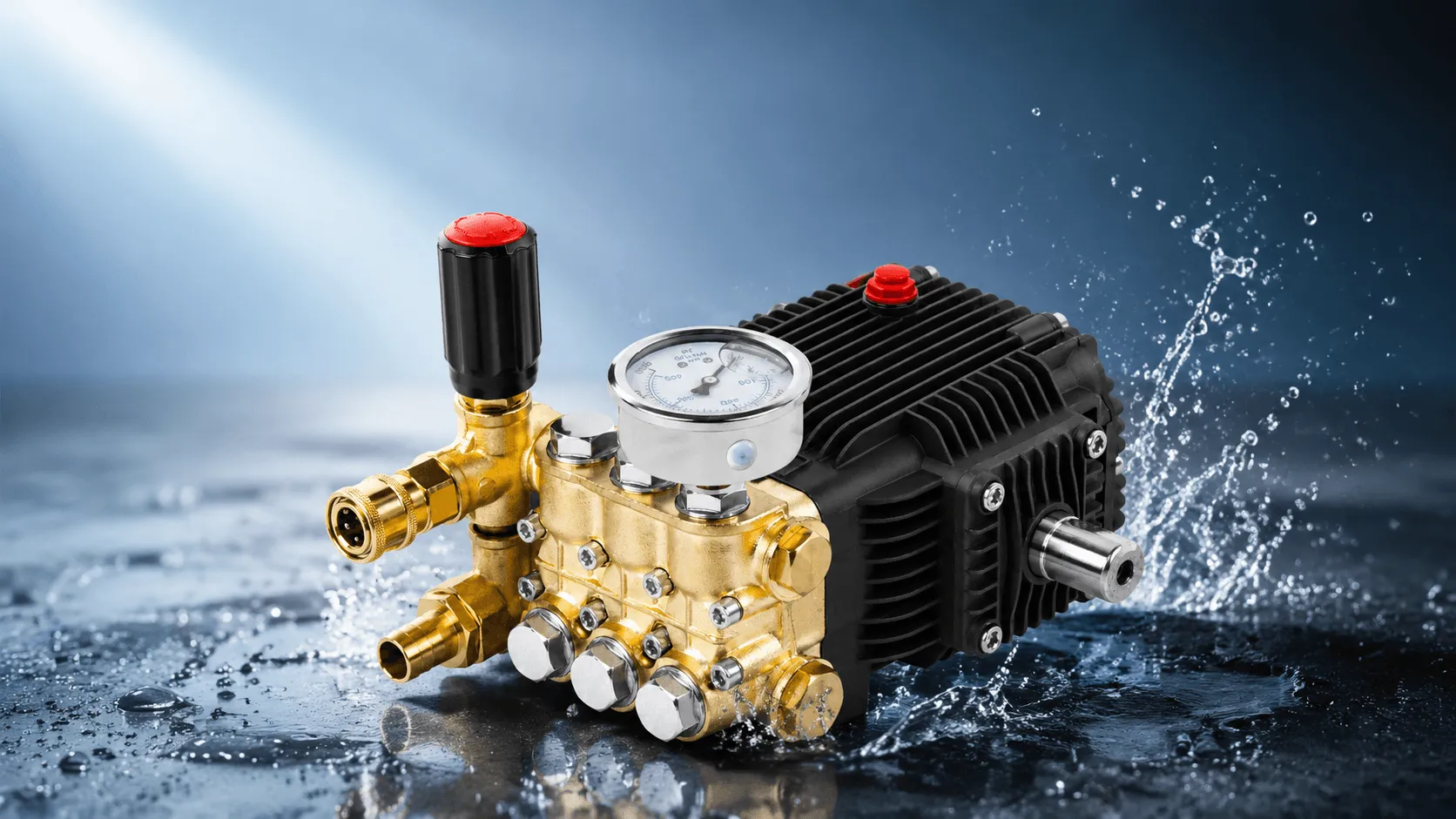



1. Introduction: The Pinnacle of Pressure Generation
Plunger pumps—also known as piston pumps, reciprocating positive displacement pumps, or high-pressure pumps—represent the most mechanically robust and pressure-capable category of fluid machinery. Unlike centrifugal pumps that generate pressure through kinetic energy conversion, or rotary positive displacement pumps that rely on rotating elements, plunger pumps use the linear reciprocating motion of a solid plunger (or piston) within a precision-machined cylinder to directly compress and displace fluid. This fundamental mechanism allows plunger pumps to achieve pressures that no other pump type can approach, routinely operating at 100–1,500 bar and reaching 3,000+ bar in specialized applications.
The global high-pressure plunger pump market exceeds $3.5 billion annually, serving critical sectors including oil & gas (well stimulation, water injection, pipeline pumping), waterjet cutting (3,000–6,000 bar), pressure washing (150–3,000 bar), reverse osmosis desalination (55–80 bar), process industries (chemical injection, homogenization), and hydrostatic testing. Their ability to deliver precise, metered flow at extreme pressures, combined with excellent efficiency across a wide viscosity range, makes them irreplaceable in applications where pressure is the primary engineering challenge. This article provides a comprehensive technical analysis of plunger pump mechanics, hydraulic design, power transmission, sealing technology, and extreme-pressure engineering.
2. Fundamental Operating Principle: Reciprocating Displacement
2.1 The Reciprocating Cycle
A plunger pump operates through a repeating four-stroke cycle driven by a crankshaft, cam, or hydraulic actuator:
表格
| Phase | Plunger Motion | Valve State | Chamber Action | Fluid Behavior |
|---|---|---|---|---|
| 1. Suction (Intake) | Plunger retracts (away from cylinder head) | Suction valve OPEN; Discharge valve CLOSED | Chamber volume increases; pressure decreases | Fluid drawn into chamber through suction valve by pressure differential |
| 2. Suction valve closure | Plunger continues retraction to maximum extent | Suction valve CLOSES (spring or gravity); Discharge valve remains CLOSED | Chamber at maximum volume; pressure at minimum | Valve closure prevents backflow; chamber fully charged |
| 3. Discharge (Delivery) | Plunger advances (toward cylinder head) | Suction valve CLOSED; Discharge valve OPEN (when pressure exceeds discharge) | Chamber volume decreases; pressure increases | Fluid compressed until pressure exceeds discharge + valve cracking pressure; fluid expelled |
| 4. Discharge valve closure | Plunger reaches top dead center (TDC) | Discharge valve CLOSES; Suction valve remains CLOSED | Chamber at minimum volume; pressure at maximum | Valve closure prevents backflow; cycle ready to repeat |
Key Distinction: The plunger itself does not contact the fluid being pumped in most designs (unlike a piston, which has sealing rings and moves within the cylinder bore). Instead, the plunger extends through a packing seal into a plunger chamber or fluid end, creating a seal at the packing rather than at the plunger surface. This design allows the plunger to be made of extremely hard, wear-resistant material while the packing (which is consumable) handles the dynamic sealing.
2.2 Theoretical Displacement & Flow
Displacement per revolution (single-acting, single-cylinder):
Vdisp=Aplunger×s=4π×Dplunger2×s
Where:
- Vdisp = Displacement per crank revolution (m³/rev)
- Aplunger = Cross-sectional area of plunger (m²)
- Dplunger = Plunger diameter (m)
- s = Stroke length (m)
Theoretical flow rate:
Qtheoretical=Vdisp×N=4π×Dplunger2×s×N
Where N = crankshaft speed (rev/s).
For multi-plunger pumps:
Qtheoretical,total=nplungers×4π×Dplunger2×s×N
Where nplungers = number of plungers (typically 1, 2, 3, 5, or 7).
For double-acting pumps (both sides of plunger displace fluid):
Qtheoretical,double=2×nplungers×4π×Dplunger2×s×N
(Note: The rod-side displacement is slightly less due to rod cross-sectional area.)
Design insight: Flow rate is directly proportional to plunger area, stroke length, speed, and number of plungers. Unlike centrifugal pumps, flow is independent of discharge pressure (within mechanical and volumetric limits), making plunger pumps ideal for metering and process control applications.
3. Classification of Plunger Pumps
3.1 By Drive Mechanism
表格
| Drive Type | Mechanism | Speed Range | Pressure Range | Efficiency | Application |
|---|---|---|---|---|---|
| Crankshaft (mechanical) | Electric motor or engine drives crankshaft via gears or belt | 100–500 RPM | 100–1,500 bar | 85–94% | Most common; industrial; mobile |
| Hydraulic drive | Hydraulic cylinder actuates plunger directly | 10–100 strokes/min | 500–3,000+ bar | 80–88% | Ultra-high pressure; waterjet; isostatic pressing |
| Pneumatic drive | Air cylinder drives plunger | 10–60 strokes/min | 50–500 bar | 60–75% | Explosion-proof; portable; low-cost |
| Linear motor (direct) | Electromagnetic linear actuator | 50–300 strokes/min | 100–500 bar | 75–85% | Precision metering; clean room; medical |
| Solenoid drive | Electromagnetic plunger actuation | 1–20 strokes/min | 10–100 bar | 50–65% | Dosing; chemical injection; analytical |
| Cam drive | Rotating cam profile drives follower/plunger | 100–1,000 RPM | 50–200 bar | 80–88% | Metering; process; uniform flow |
3.2 By Number of Plungers & Arrangement
表格
| Configuration | Plunger Count | Phasing | Pulsation Level | Flow Smoothness | Typical Application |
|---|---|---|---|---|---|
| Simplex (single) | 1 | N/A | Very high | Very poor | Small metering; laboratory; hand-operated |
| Duplex (double) | 2 | 180° apart | High | Poor | Small industrial; pressure washing; chemical feed |
| Triplex (triple) | 3 | 120° apart | Moderate | Good | Most common industrial; oil & gas; waterjet; process |
| Quintuplex (five) | 5 | 72° apart | Low | Very good | Large flow; pipeline; minimal pulsation required |
| Septuplex (seven) | 7 | 51.4° apart | Very low | Excellent | Maximum flow smoothness; sensitive downstream equipment |
| Multiplex (custom) | 9, 11+ | Evenly spaced | Minimal | Near-continuous | Specialized process; military; aerospace |
Pulsation Frequency:
fpulsation=N×nplungers
Where:
- fpulsation = Pulses per minute
- N = Crankshaft speed (RPM)
- nplungers = Number of plungers
Example: A triplex pump at 350 RPM:
fpulsation=350×3=1,050 pulses/min=17.5 Hz
Flow Pulsation Amplitude:
The theoretical flow variation (pulsation) decreases with more plungers:
表格
| Plunger Count | Theoretical Pulsation (% of mean flow) | Practical Pulsation (with dampener) |
|---|---|---|
| 1 (simplex) | ±100% | ±80–95% |
| 2 (duplex) | ±50% | ±30–40% |
| 3 (triplex) | ±14% | ±5–10% |
| 5 (quintuplex) | ±5% | ±2–4% |
| 7 (septuplex) | ±2.5% | ±1–2% |
Triplex pumps have become the industry standard because they offer an optimal balance of mechanical simplicity, flow smoothness, and cost. The 120° phasing creates overlapping discharge strokes that maintain relatively continuous flow, while the three-throw crankshaft is statically and dynamically balanced, minimizing vibration.
3.3 By Application & Pressure Class
表格
| Pressure Class | Range | Typical Applications | Plunger Material | Packing Material |
|---|---|---|---|---|
| Low pressure | 10–100 bar | Chemical metering; dosing; spray systems | Stainless steel 316; coated steel | PTFE; NBR; EPDM |
| Medium pressure | 100–400 bar | Pressure washing; reverse osmosis; process injection | Stainless steel 316; ceramic-coated | Aramid fiber; PTFE composite; leather |
| High pressure | 400–1,000 bar | Oil & gas well stimulation; pipeline hydrotesting | Tungsten carbide; ceramic; diamond-coated | Carbon fiber; PEEK; specialized composites |
| Ultra-high pressure | 1,000–4,000 bar | Waterjet cutting; isostatic pressing; high-pressure research | Synthetic sapphire; diamond; tungsten carbide | Specialized ultra-high-pressure packing; metal-to-metal seals |
| Extreme pressure | > 4,000 bar | Research; diamond synthesis; special processes | Diamond; polycrystalline diamond | Metal bellows; unsupported area seals |
4. Core Engineering Equations
4.1 Pressure-Force Relationship
The fundamental relationship governing plunger pump design:
Fplunger=Pdischarge×Aplunger=Pdischarge×4π×Dplunger2
Where:
- Fplunger = Force on plunger during discharge stroke (N)
- Pdischarge = Discharge pressure (Pa)
- Aplunger = Plunger cross-sectional area (m²)
- Dplunger = Plunger diameter (m)
Crankshaft Torque:
For a crank-driven pump, the torque required varies throughout the stroke:
T(θ)=Fplunger×rcrank×sin(θ)×1−λ2sin2(θ)cos(θ)
Where:
- T(θ) = Instantaneous torque at crank angle θ (N·m)
- rcrank = Crank radius = stroke/2 (m)
- θ = Crank angle from top dead center (°)
- λ=rcrank/Lrod = Crank radius to connecting rod length ratio (typically 0.2–0.3)
Simplified average torque (per plunger):
Tavg=2Fplunger×rcrank=4Pdischarge×Aplunger×s
Total torque for multi-plunger pump:
Ttotal=4×ηmechanicalPdischarge×Aplunger×s×nplungers
Where ηmechanical = mechanical efficiency (accounts for friction in bearings, crosshead, packing).
Critical design insight: Plunger force increases with the square of plunger diameter at constant pressure. A 20% increase in plunger diameter increases force by 44%, requiring proportionally stronger crankshaft, bearings, and frame. This is why high-pressure pumps use small-diameter plungers (10–50 mm) rather than large pistons.
4.2 Power Requirement
Hydraulic (theoretical) power:
Phydraulic=Qactual×ΔP
Shaft power (at crankshaft):
Pshaft=ηvolumetric×ηmechanicalPhydraulic
Motor input power:
Pmotor=ηmotorPshaft
For a triplex pump (simplified):
Pshaft=ηtotal3×4π×D2×s×N×Pdischarge
Where:
- D = Plunger diameter (m)
- s = Stroke (m)
- N = Speed (rev/s)
- Pdischarge = Discharge pressure (Pa)
- ηtotal = Total efficiency (volumetric × mechanical)
Typical Efficiency Ranges:
表格
| Component | Efficiency Range | Factors Affecting |
|---|---|---|
| Volumetric | 85–98% | Valve leakage; packing leakage; fluid compressibility; valve timing |
| Mechanical | 85–95% | Bearing friction; crosshead friction; packing friction; gear/belt losses |
| Total (pump) | 75–92% | Combined volumetric + mechanical; typically 80–88% for well-designed triplex |
| Motor | 88–96% (IE3–IE4) | Motor size; speed; load factor |
| Wire-to-water | 70–85% | Overall system efficiency from electrical input to hydraulic output |
Plunger pumps are among the most efficient pump types because the direct mechanical displacement minimizes hydraulic losses. Well-designed triplex pumps achieve 85–92% total efficiency—higher than most centrifugal pumps and comparable to the best rotary PD pumps.
4.3 Volumetric Efficiency & Slip
Volumetric efficiency in plunger pumps is affected by:
表格
| Loss Mechanism | Cause | Magnitude | Mitigation |
|---|---|---|---|
| Packing leakage | Fluid bypasses plunger through packing seal | 1–5% of flow (new); 5–15% (worn) | Proper packing selection; correct gland load; regular maintenance |
| Valve leakage | Fluid backflows through suction/discharge valves when closed | 0.5–2% (new); 2–8% (worn) | Hardened valve seats; proper spring force; clean fluid |
| Fluid compressibility | Fluid compresses under high pressure before valve opens | 0.5–3% (water at 1,000 bar); higher for compressible fluids | Pre-compression design; minimize dead volume |
| Valve timing (late closing) | Suction valve closes after plunger begins discharge stroke | 1–5% | Optimize valve dynamics; spring rate; minimize valve mass |
| Dead volume (clearance volume) | Unswept volume at TDC reduces effective displacement | 0.5–2% | Minimize clearance; tapered plunger design |
Volumetric Efficiency Equation:
ηvol=QtheoreticalQactual=1−QtheoreticalQslip,packing+Qslip,valve+Qcompressibility
Compressibility Correction (high pressure):
For water at extreme pressures, compressibility becomes significant:
Qactual=Qtheoretical×(1−KbulkΔP)
Where Kbulk = bulk modulus of fluid (≈ 2.2 GPa for water at 20°C).
At 1,000 bar (100 MPa):
KbulkΔP=2,200100=0.045=4.5%
This means 4.5% of theoretical displacement is lost to fluid compression before the discharge valve opens. For ultra-high-pressure pumps, this compressibility loss is a dominant design consideration.
4.4 Plunger Velocity & Acceleration
Instantaneous plunger velocity:
v(θ)=ω×rcrank×(sin(θ)+21−λ2sin2(θ)λ×sin(2θ))
Where ω=2πN = angular velocity (rad/s).
Maximum velocity (approximate, at mid-stroke):
vmax≈ω×rcrank=π×N×s
Instantaneous plunger acceleration:
a(θ)=ω2×rcrank×(cos(θ)+λ×cos(2θ))
Maximum acceleration (at TDC and BDC):
amax=ω2×rcrank×(1+λ)
Design Implications:
表格
| Parameter | Effect of High Acceleration | Design Response |
|---|---|---|
| Inertial forces | High forces on crosshead, bearings, frame | Robust frame design; limit speed; balance reciprocating masses |
| Valve dynamics | Valve must close before plunger reverses | Optimize valve mass, spring rate, lift height |
| Cavitation at suction | Rapid plunger acceleration creates low pressure spikes | Increase NPSHA; reduce speed; optimize suction valve |
| Flow pulsation | Velocity variation creates pressure pulsation | More plungers; pulsation dampeners; accumulators |
| Vibration | Unbalanced reciprocating forces | Counterweights; multicylinder phasing; rigid mounting |
4.5 NPSH & Suction Conditions
Plunger pumps have unique NPSH requirements due to the intermittent, accelerating suction flow:
NPSH Required:
NPSHR=2gVsuction,max2+Hf,suction+Hacceleration+Hvalve
Where:
- Vsuction,max = Maximum suction port velocity during intake stroke (m/s)
- Hf,suction = Friction losses in suction line (m)
- Hacceleration = Head required to accelerate fluid column (m)
- Hvalve = Pressure drop across suction valve (m)
Acceleration head (most critical for plunger pumps):
Hacceleration=g×KLsuction×vplunger×N×C
Where:
- Lsuction = Length of suction line (m)
- vplunger = Average plunger velocity (m/s)
- N = Pump speed (RPM)
- C = Pump type constant (0.4 for simplex, 0.2 for duplex, 0.115 for triplex, 0.066 for quintuplex)
- K = Fluid modulus factor (≈ 1.0 for water; < 1.0 for hot water or hydrocarbons)
Simplified acceleration head (for triplex):
Hacceleration≈1,800×gLsuction×s×N2
Design Rule:
NPSHA≥2.0×NPSHR(for plunger pumps; higher margin due to acceleration effects)
Critical suction design practices:
- Short suction lines: Minimize Lsuction to reduce acceleration head
- Oversized suction pipe: Reduce Vsuction and Hf
- Suction stabilizer: Pneumatic or bladder accumulator at pump inlet absorbs acceleration pulses
- Speed limitation: Lower speed reduces acceleration head proportionally to N2
- Elevated supply tank: Increase static head to overcome acceleration losses
Suction failure (cavitation) in plunger pumps manifests as valve knocking, erratic flow, and accelerated valve/packing wear—not the typical impeller pitting seen in centrifugal pumps. The intermittent nature of plunger pump suction makes NPSH analysis more complex and demands conservative design margins.
4.6 Discharge Pulsation & Dampening
Even with multiple plungers, discharge pulsation is significant and must be managed:
Pulsation amplitude (theoretical, no dampening):
For a triplex pump:
QmeanΔQmax≈0.14=14%
Pressure pulsation (without dampener):
ΔPmax=ρ×awave×ΔV
Where:
- ρ = Fluid density (kg/m³)
- awave = Wave speed in fluid/pipe system (m/s)
- ΔV = Velocity variation due to flow pulsation (m/s)
Wave speed (water hammer velocity):
awave=1+Epipe×twallKbulk×DKbulk/ρ
Where:
- Kbulk = Fluid bulk modulus (Pa)
- Epipe = Pipe material Young’s modulus (Pa)
- D = Pipe internal diameter (m)
- twall = Pipe wall thickness (m)
For water in steel pipe: awave ≈ 1,000–1,400 m/s.
Pulsation Dampener Sizing:
Vdampener=ΔPacceptable/PprechargeQpulsation×Tpulse
Where:
- Qpulsation = Peak-to-peak flow variation (m³)
- Tpulse = Pulse period (s)
- ΔPacceptable = Acceptable pressure variation (Pa)
- Pprecharge = Gas precharge pressure (typically 60–80% of operating pressure)
Typical dampener effectiveness:
表格
| Dampener Type | Attenuation | Cost | Maintenance | Application |
|---|---|---|---|---|
| Bladder accumulator | 70–90% | Moderate | Bladder replacement (3–5 years) | Most common; versatile |
| Piston accumulator | 60–80% | Higher | Seal maintenance | High pressure; high temperature |
| In-line dampener (choke tube) | 40–60% | Low | None | Budget installations; less critical |
| Active dampener (fast valve) | 80–95% | High | Electronics | Precision process; research |
| Volume bottle (no bladder) | 30–50% | Very low | None | Minimal dampening; surge protection |
API 674 (Positive Displacement Pumps—Reciprocating) provides detailed guidelines for pulsation and vibration control in plunger pump installations, including design criteria for suction and discharge pulsation dampeners.
5. Structural Design & Power End Engineering
5.1 The Power End (Drive Mechanism)
表格
| Component | Function | Design Considerations | Material |
|---|---|---|---|
| Crankshaft | Converts rotary motion to reciprocating motion | Fatigue strength; torsional vibration; bearing journal size | Forged steel; nitrided or induction hardened |
| Connecting rod | Transmits force from crankshaft to crosshead | Buckling resistance; bearing ratio; weight minimization | Forged steel; bronze small end bearing |
| Crosshead | Guides plunger in linear motion; absorbs side loads | Wear resistance; alignment precision; lubrication | Cast iron; bronze; steel with babbitt lining |
| Crosshead pin | Pivot between connecting rod and crosshead | Hardened; precision-ground; lubricated | Hardened steel; surface-coated |
| Frame / housing | Supports all components; contains lubrication system | Rigidity; fatigue resistance; vibration damping | Cast iron; fabricated steel; nodular iron |
| Main bearings | Support crankshaft; handle radial and thrust loads | Size for load and L10 life; oil film lubrication | Rolling element or hydrodynamic journal bearings |
| Gear reducer (if used) | Matches motor speed to pump speed | Efficiency; noise; backlash; torque capacity | Hardened steel gears; precision ground |
| Belt drive (if used) | Flexible speed matching; vibration isolation | Belt tension; pulley ratio; belt life | V-belt or synchronous belt; cast iron pulleys |
| Flywheel | Smooths torque pulsation; stores rotational energy | Inertia calculation; speed fluctuation limit | Cast iron; steel |
Crankshaft Design Stresses:
The crankshaft must withstand:
- Bending stress from plunger force
- Torsional stress from torque transmission
- Combined fatigue stress (alternating + mean)
Safety factor: Typically 2.5–4.0 against fatigue failure, accounting for stress concentrations at fillets and oil holes.
5.2 The Fluid End (Wetted Components)
表格
| Component | Function | Design Challenge | Material |
|---|---|---|---|
| Cylinder / liner | Contains fluid during compression; guides plunger | Wear; corrosion; cavitation; thermal fatigue | Hardened steel; ceramic; tungsten carbide coating |
| Plunger | Displaces fluid; withstands pressure; resists wear | Surface finish; hardness; alignment; thermal expansion | Tungsten carbide; ceramic; hardened stainless steel; chrome-plated |
| Packing seal | Dynamic seal between plunger and atmosphere | High-pressure sealing; wear; heat; chemical compatibility | Aramid fiber; PTFE; carbon; PEEK; leather; specialized composites |
| Packing gland / follower | Compresses packing to achieve seal; adjustable | Uniform load distribution; corrosion resistance; adjustability | Stainless steel; bronze; coated steel |
| Suction valve | Opens during intake; closes during discharge | Rapid response; positive seal; wear resistance; corrosion | Stainless steel; hastelloy; ceramic; coated steel |
| Discharge valve | Opens during discharge; closes during intake | Rapid response; positive seal; wear resistance; pressure rating | Same as suction valve; often identical design |
| Valve seat | Provides sealing surface for valve | Hardness; corrosion resistance; replaceability | Hardened steel; stellite; ceramic; tungsten carbide |
| Valve spring | Ensures valve closure timing | Fatigue life; corrosion resistance; rate matching | Stainless steel; Inconel; elgiloy |
| Manifold / head | Collects discharge from multiple cylinders; distributes suction | Pressure containment; fatigue; corrosion; flow distribution | Forged steel; stainless steel; duplex; super duplex |
| Check valve (discharge) | Prevents backflow into pump | Pressure rating; positive seal; low cracking pressure | Same as discharge valve |
5.3 Plunger Design & Materials
表格
| Material | Hardness | Wear Resistance | Corrosion Resistance | Cost | Application |
|---|---|---|---|---|---|
| Hardened stainless steel (17-4 PH) | 38–42 HRC | Good | Good | Low | General industrial; water; mild chemicals |
| Chrome-plated steel | 65–72 HRC (chrome layer) | Very good | Good (chrome layer) | Low–moderate | Standard industrial; water; oil |
| Ceramic (Al₂O₃, ZrO₂) | 85+ HRC | Excellent | Excellent | Moderate | Abrasive; corrosive; high temperature |
| Tungsten carbide (WC-Co) | 88–92 HRA | Exceptional | Good | High | Ultra-abrasive; high pressure; extended life |
| Silicon carbide (SiC) | 90+ HRA | Exceptional | Excellent | High | Chemical; abrasive; high temperature |
| Diamond coating (CVD) | 10,000+ Vickers | Ultimate | Excellent | Very high | Extreme abrasion; ultra-high pressure; research |
| Synthetic sapphire | 9 Mohs | Excellent | Excellent | Very high | Ultra-pure; medical; research; metering |
Plunger Surface Finish:
表格
| Application | Required Ra | Achieved By | Purpose |
|---|---|---|---|
| Standard industrial | 0.4–0.8 µm | Grinding; polishing | Acceptable packing life; standard performance |
| High-pressure | 0.2–0.4 µm | Precision grinding; lapping | Extended packing life; reduced leakage |
| Ultra-high-pressure | 0.05–0.2 µm | Superfinishing; lapping; polishing | Maximum packing life; minimum leakage; minimal friction |
| Medical / pharmaceutical | 0.05–0.1 µm | Superfinishing; electropolishing | Sterility; zero contamination; minimal shear |
Plunger surface finish is critical to packing life. A 50% improvement in surface finish (e.g., from 0.4 µm to 0.2 µm Ra) can double or triple packing life by reducing abrasive wear and allowing the packing to conform more effectively to the plunger surface.
5.4 Packing Seal Technology
The packing seal is the most critical and most frequently replaced component in a plunger pump. It must:
- Seal against high pressure (up to 4,000+ bar)
- Accommodate plunger reciprocation (millions of cycles)
- Resist chemical attack from pumped fluid
- Dissipate frictional heat
- Allow minimal leakage (for cooling and lubrication)
表格
| Packing Type | Construction | Pressure Range | Temperature | Leakage | Life | Application |
|---|---|---|---|---|---|---|
| Braided fiber (aramid, PTFE) | Interwoven fibers with lubricant | Up to 500 bar | −50 to +150°C | Low | Moderate | General industrial; water; chemicals |
| Molded composite (carbon/PTFE) | Molded rings with fabric reinforcement | Up to 1,000 bar | −50 to +200°C | Very low | Good | High pressure; oil & gas; process |
| Chevron (V-ring) stack | Multiple V-shaped rings in set | Up to 700 bar | −30 to +120°C | Low | Good | Hydraulic; medium pressure |
| Piston ring type | Segmented rings with expander | Up to 300 bar | −40 to +200°C | Moderate | Very good | Low speed; high temperature; oil |
| Metal bellows seal | Welded metal bellows (no elastomer) | Up to 2,000 bar | −200 to +400°C | Very low | Excellent | High temperature; cryogenic; ultra-high purity |
| Unsupported area seal | Precision metal-to-metal contact | Up to 10,000+ bar | Unlimited | Minimal | Very good | Research; extreme pressure; limited life |
| Elastomer O-ring (backup) | Secondary seal behind primary packing | Up to 500 bar | −30 to +150°C | Backup only | N/A | Leakage containment; environmental protection |
Packing Load & Adjustment:
The packing gland must apply sufficient force to achieve sealing without excessive friction:
Fgland=Pdischarge×Aplunger×Kpacking
Where Kpacking = packing friction coefficient (typically 0.1–0.3 depending on material and lubrication).
Initial gland torque: Set to manufacturer specification (typically 10–20 N·m for small pumps; 50–200 N·m for large pumps).
Break-in procedure: Run at 50% pressure for 30–60 minutes; re-torque gland; gradually increase to full pressure.
Maintenance: Re-torque gland daily during first week; then weekly. Replace packing when leakage exceeds allowable rate (typically 1–5 drops/minute per plunger).
6. Valve Design & Dynamics
6.1 Valve Types for Plunger Pumps
表格
| Valve Type | Construction | Speed Capability | Pressure Capability | Application |
|---|---|---|---|---|
| Ball valve | Spherical ball on seat; spring-loaded | Moderate (up to 300 RPM) | Up to 500 bar | Small pumps; metering; chemical feed |
| Disc (poppet) valve | Flat or conical disc on seat; spring-loaded | High (up to 500 RPM) | Up to 1,500 bar | Most common; triplex; industrial |
| Plate valve | Multi-ring plate with spring; large flow area | High (up to 400 RPM) | Up to 1,000 bar | Large flow; low resistance; water |
| Ring valve | Concentric ring segments; spring-loaded | Moderate (up to 250 RPM) | Up to 700 bar | Large flow; viscous fluids; slurry |
| Duckbill valve | Elastomer duckbill; no spring | Low (up to 100 RPM) | Up to 50 bar | Sanitary; food; medical; no metal contact |
| Active valve (solenoid) | Electromagnetically actuated | Very high (unlimited) | Up to 200 bar | Precision metering; digital control; research |
6.2 Valve Dynamics Equation
The valve must open and close within the available time window:
tvalve=Fspring+Fhydraulic−Fgravity2×mvalve×hlift
Where:
- tvalve = Valve opening/closing time (s)
- mvalve = Valve mass (kg)
- hlift = Valve lift height (m)
- Fspring = Spring force (N)
- Fhydraulic = Hydraulic force on valve (N)
- Fgravity = Weight of valve (N)
Design requirement:
tvalve<N×nplungers60×kmargin
Where kmargin = safety factor (typically 0.3–0.5, meaning valve must act in 30–50% of available time).
For a triplex pump at 350 RPM:
Available time per valve event = 60/(350×3)=0.057 s = 57 ms
Required valve actuation time < 0.3 × 57 = 17 ms
Valve dynamics are critical to pump performance. A slow-closing suction valve causes backflow (reduced volumetric efficiency), while a slow-closing discharge valve causes recompression (increased power, pulsation). Valve design must balance low mass (fast response), adequate flow area (low pressure drop), and positive sealing (minimal leakage).
7. Application Engineering & System Design
7.1 System Design Fundamentals
表格
| Element | Design Consideration | Plunger Pump Specific Requirement |
|---|---|---|
| Suction line | Short, large diameter, minimal fittings | Critical due to acceleration head; suction stabilizer strongly recommended |
| Suction strainer | 50–100 mesh; low pressure drop | Protects valves from debris; must be cleaned regularly |
| Discharge line | Sized for velocity < 3 m/s; rated for 1.5× max pressure | Water hammer protection; pulsation dampener essential |
| Relief valve | Mandatory; set 10% above operating pressure | Critical: Plunger pumps generate infinite pressure if blocked; catastrophic failure without relief |
| Pressure gauge | Isolation valve + snubber (pulsation protection) | Snubber protects gauge from pulsation damage |
| Pulsation dampener | Bladder or piston type; sized per API 674 | Reduces pulsation 70–90%; protects piping and downstream equipment |
| Flow measurement | Pulsation-resistant (mass flow, magnetic, or averaging) | Standard flow meters fail with pulsating flow; use dampened or mass-based |
| Temperature monitoring | Suction and discharge | High discharge temperature indicates excessive friction or compression |
| Vibration monitoring | Frame-mounted accelerometers | Detects bearing wear, looseness, valve problems |
7.2 Pressure Washer System Design
表格
| Parameter | Light Duty | Medium Duty | Heavy Duty | Ultra-Heavy Duty |
|---|---|---|---|---|
| Pressure | 50–150 bar | 150–300 bar | 300–500 bar | 500–3,000 bar |
| Flow | 5–15 L/min | 15–30 L/min | 30–50 L/min | 10–50 L/min |
| Power | 2–5 kW | 5–15 kW | 15–30 kW | 30–150 kW |
| Plunger material | Chrome-plated steel | Ceramic-coated steel | Tungsten carbide | Tungsten carbide / ceramic |
| Pump type | Triplex; direct drive (1,450 RPM) | Triplex; belt drive (500–800 RPM) | Triplex; gearbox (300–500 RPM) | Triplex; gearbox (200–400 RPM) |
| Seal life | 200–500 hours | 500–1,000 hours | 1,000–2,000 hours | 500–1,500 hours |
| Application | Home; garden; light cleaning | Commercial; vehicle wash; surface prep | Industrial; paint removal; concrete | Ship hull; waterjet cutting; surface treatment |
7.3 Oil & Gas Well Stimulation
表格
| Parameter | Fracturing (Fracking) | Acidizing | Water Injection |
|---|---|---|---|
| Pressure | 500–1,200 bar | 200–700 bar | 150–400 bar |
| Flow | 5–20 m³/min (per pump) | 1–5 m³/min | 5–50 m³/min |
| Power | 1,500–3,000 kW per pump | 300–1,000 kW | 500–3,000 kW |
| Fluid | Proppant slurry (sand + gel) | Acid (HCl, HF, organic) | Seawater; produced water; fresh water |
| Plunger material | Tungsten carbide; ceramic | Hastelloy; titanium; ceramic | Chrome-plated; stainless steel |
| Valve material | Tungsten carbide; stellite | Hastelloy; titanium | Stainless steel; stellite |
| Packing | Aramid fiber; specialized composites | PTFE; Viton; acid-resistant | Standard aramid; PTFE |
| Pump count | 10–50 pumps per fleet | 1–5 pumps | 1–10 pumps per station |
| Redundancy | N+1 within fleet | N+1 | N+1 or 2N |
Fracturing pumps are among the largest and most powerful plunger pumps in existence. A single quintuplex fracturing pump can deliver 3,000+ kW at 1,000+ bar, consuming more power than a locomotive. These pumps operate in harsh desert or arctic conditions, handling abrasive proppant slurries that destroy lesser equipment.
7.4 Reverse Osmosis (RO) & Desalination
表格
| Parameter | Seawater RO | Brackish Water RO | Industrial RO |
|---|---|---|---|
| Pressure | 55–80 bar | 15–30 bar | 20–60 bar |
| Flow | 50–500 m³/hr per train | 100–1,000 m³/hr | 10–200 m³/hr |
| Pump type | High-pressure centrifugal (primary); plunger (energy recovery) | Centrifugal | Plunger or centrifugal |
| Energy recovery | PX (pressure exchanger) or turbocharger; plunger ERD emerging | Not typically required | Not typically required |
| Plunger role | Energy recovery device (ERD); booster | N/A | High-pressure chemical injection |
| Efficiency target | > 90% (wire-to-water with ERD) | > 85% | > 80% |
| Material | Duplex SS; super duplex | Stainless steel 316L | Stainless steel 316L; duplex |
| Maintenance interval | 8,000–16,000 hours | 16,000–24,000 hours | 8,000–16,000 hours |
7.5 Waterjet Cutting
表格
| Parameter | Pure Waterjet | Abrasive Waterjet |
|---|---|---|
| Pressure | 3,000–4,000 bar | 3,000–6,000 bar |
| Flow | 0.5–5 L/min | 0.5–3 L/min |
| Orifice diameter | 0.1–0.4 mm | 0.2–0.5 mm |
| Cutting speed | Fast (soft materials) | Moderate (hard materials) |
| Materials cut | Foam; rubber; food; paper | Metal; stone; glass; ceramic; composite |
| Pump type | Intensifier (hydraulic-driven plunger) | Intensifier |
| Intensifier ratio | 20:1 to 40:1 (hydraulic:water pressure) | 20:1 to 40:1 |
| Plunger material | Tungsten carbide; ceramic | Tungsten carbide; ceramic |
| Seal technology | Specialized ultra-high-pressure packing | Same |
| Orifice material | Sapphire; ruby; diamond | Same |
| Abrasive | None | Garnet; 80–120 mesh; 0.2–1.0 kg/min |
Intensifier Principle:
A hydraulic-driven plunger pump (oil at 200 bar) drives a large-diameter piston that is coupled to a small-diameter water plunger. The pressure intensification follows:
Pwater=Poil×AsmallAlarge=Poil×(DsmallDlarge)2
For a 20:1 intensifier with 200 bar hydraulic pressure:
Pwater=200×20=4,000 bar
Waterjet intensifiers are a specialized application of plunger pump technology where the hydraulic drive plunger and water compression plunger are coaxial, with the large hydraulic piston directly driving the small water plunger. This achieves pressures impossible with direct mechanical drive.
8. Material Selection for Extreme Environments
8.1 Fluid End Material Matrix
表格
| Material | Max Pressure | Corrosion Resistance | Abrasion Resistance | Cost | Application |
|---|---|---|---|---|---|
| Carbon steel (forged) | 1,500 bar | Poor (requires coating) | Moderate | Low | Non-corrosive oil & gas; general industrial |
| Stainless steel 316/316L (forged) | 1,000 bar | Good | Moderate | Moderate | Water; mild chemicals; food; pharmaceutical |
| Duplex SS 2205 (forged) | 1,200 bar | Excellent | Good | High | Seawater; aggressive chemicals; oil & gas |
| Super duplex 2507 | 1,500 bar | Exceptional | Good | Very high | Offshore; sour service; chloride-rich |
| Hastelloy C-276 | 1,000 bar | Exceptional (acids) | Moderate | Very high | Strong acids; chlorine dioxide; chemical process |
| Titanium (forged) | 800 bar | Exceptional | Good | Very high | Seawater; hypochlorite; ultra-pure |
| Inconel 625 | 1,200 bar | Excellent | Good | Very high | High temperature; sour gas; nuclear |
| Monel 400 | 800 bar | Excellent (seawater) | Moderate | High | Marine; seawater; chemical |
| Ceramic (fluid end liner) | 500 bar | Inert | Excellent | Moderate | Abrasive; corrosive; insert into steel housing |
8.2 Material Selection by Fluid
表格
| Fluid | pH | Chlorides | Solids | Temperature | Recommended Material |
|---|---|---|---|---|---|
| Fresh water | 6.5–8.5 | < 50 ppm | None | < 80°C | Carbon steel; SS 304 |
| Seawater | 7.5–8.5 | 19,000 ppm | Sand | < 40°C | Duplex 2205; super duplex; titanium |
| Produced water (oil & gas) | 4–8 | 50–200,000 ppm | Oil; sand; scale | < 120°C | Duplex 2205; super duplex; Inconel |
| Hydrochloric acid | < 1 | High | None | < 60°C | Hastelloy C; titanium; ceramic |
| Sulfuric acid | < 1 | Low | None | < 80°C | Hastelloy C; alloy 20; ceramic |
| Caustic soda (NaOH) | > 13 | Low | None | < 80°C | Nickel; Monel; SS 316L |
| Ammonia | 10–12 | Low | None | < 60°C | Carbon steel; SS 316L (no copper alloys) |
| Crude oil | 5–7 | Variable | Sand; wax; asphaltenes | < 150°C | Carbon steel; SS 316L; duplex |
| Proppant slurry | 6–8 | Variable | Sand (up to 20% by volume) | < 80°C | Tungsten carbide components; hardened steel |
9. Maintenance & Reliability
9.1 Predictive Maintenance for Plunger Pumps
表格
| Method | Frequency | Indicators | Action Threshold |
|---|---|---|---|
| Packing leakage rate | Daily (visual) | Worn packing; misalignment; scored plunger | Exceeds 5 drops/min per plunger |
| Discharge pressure stability | Continuous | Valve wear; packing leakage; system changes | Pressure variation > 10% from baseline |
| Flow rate measurement | Weekly | Volumetric efficiency decline; valve problems | > 5% drop from baseline at same speed/pressure |
| Vibration analysis | Monthly | Bearing wear; loose components; valve impact | ISO 10816 limits; new tonal frequencies |
| Oil analysis (power end) | Quarterly | Bearing wear; lubricant degradation; contamination | Fe > 50 ppm; viscosity change > 10%; water > 500 ppm |
| Valve inspection | 2,000–4,000 hours | Seat wear; spring fatigue; corrosion; buildup | Visible wear > 0.5 mm; spring set > 10% |
| Plunger inspection | 4,000–8,000 hours | Scoring; wear; corrosion; coating damage | Scratch depth > 0.05 mm; wear > 0.1 mm diameter |
| Packing replacement | 500–4,000 hours (application dependent) | Leakage; hardening; extrusion; chemical attack | Scheduled or when leakage exceeds limit |
| Torque trending (crankshaft) | Monthly | Bearing degradation; packing friction increase; valve problems | > 10% increase from baseline |
| Temperature monitoring | Continuous (if fitted) | Packing overheating; bearing failure; friction increase | Packing > 100°C; bearing > 90°C; discharge > design limit |
9.2 Rebuild Intervals
表格
| Component | Light Duty (Clean Water) | Medium Duty (Industrial) | Heavy Duty (Oil & Gas, Abrasive) | Rebuild Cost (% of New) |
|---|---|---|---|---|
| Packing | 2,000–4,000 hours | 1,000–2,000 hours | 250–1,000 hours | 2–5% |
| Valves | 8,000–16,000 hours | 4,000–8,000 hours | 1,000–4,000 hours | 5–10% |
| Plunger | 16,000–32,000 hours | 8,000–16,000 hours | 4,000–8,000 hours | 10–15% |
| Bearings (power end) | 16,000–32,000 hours | 8,000–16,000 hours | 8,000–12,000 hours | 5–10% |
| Crosshead / slider | 32,000–64,000 hours | 16,000–32,000 hours | 8,000–16,000 hours | 10–15% |
| Crankshaft | 64,000+ hours | 32,000–64,000 hours | 16,000–32,000 hours | 20–30% |
| Fluid end (complete) | 32,000–64,000 hours | 16,000–32,000 hours | 8,000–16,000 hours | 30–40% |
| Complete pump rebuild | — | — | — | 40–60% |
9.3 Common Failure Modes & Diagnostics
表格
| Symptom | Probable Cause | Verification | Corrective Action |
|---|---|---|---|
| Flow loss / pressure drop | Worn packing (high slip); worn valves (leakage); worn plunger (increased clearance); speed reduction; suction problems | Measure leakage; inspect valves; measure plunger; verify speed; check NPSHA | Replace packing; replace valves; replace/rechrome plunger; verify drive; address suction |
| Excessive packing leakage | Worn packing; scored plunger; misalignment; over/under-tightened gland; wrong packing material; excessive pressure | Visual inspection; plunger surface check; alignment check; gland torque; material verification; pressure gauge | Replace packing; polish/replace plunger; realign; adjust gland torque; upgrade packing material; verify pressure |
| Valve knocking / noise | Worn valve seat; broken spring; debris under valve; excessive lift; slow closure | Visual inspection; spring test; debris check; lift measurement; valve dynamics timing | Replace valve/seat; replace spring; clean thoroughly; adjust lift; optimize spring rate |
| Excessive vibration | Worn bearings; loose bolts; unbalanced crankshaft; misalignment; valve impact; cavitation | Vibration spectrum; bolt torque check; balance check; alignment; valve timing; NPSH calculation | Replace bearings; tighten bolts; rebalance; realign; replace valves; increase NPSHA |
| Overheating (power end) | Low oil level; wrong oil viscosity; bearing failure; excessive load; blocked cooler | Oil level check; viscosity test; bearing inspection; load measurement; cooler inspection | Fill oil; change oil; replace bearings; reduce load; clean cooler |
| Overheating (fluid end) | Insufficient cooling flow; excessive packing friction; excessive pressure; hot fluid | Cooling flow check; packing torque; pressure gauge; fluid temperature | Increase cooling; adjust packing; verify pressure; cool fluid |
| Catastrophic failure (seizure) | Lubrication loss; contamination; bearing failure; overpressure; foreign object | Post-failure inspection; oil analysis; debris analysis; pressure records | Root cause analysis; upgrade filtration; improve monitoring; install additional protection |
| Premature packing wear | Scored plunger; wrong packing; over-tightened gland; abrasive fluid; chemical attack; misalignment | Plunger inspection; material check; gland torque; fluid analysis; alignment check | Polish/replace plunger; upgrade packing; adjust torque; add filtration; change material; realign |
| Pressure pulsation increase | Worn valves (uneven flow); broken spring; packing leakage variation; dampener failure | Valve inspection; spring test; leakage measurement; dampener pressure check | Replace valves/springs; replace packing; service dampener |
10. Energy Efficiency & Optimization
10.1 Efficiency Comparison: Plunger vs. Other Pump Types
表格
| Parameter | Centrifugal | Rotary PD | Plunger (Triplex) | Advantage |
|---|---|---|---|---|
| Peak efficiency | 75–88% | 70–92% | 80–92% | Plunger (high pressure) |
| High-pressure efficiency | Poor (< 50% above 100 bar) | Moderate (60–80%) | Excellent (80–92%) | Plunger |
| High-viscosity efficiency | Poor (< 40% above 1,000 cP) | Excellent (90–98%) | Good (80–90%) | Rotary PD |
| Flow pulsation | Minimal | Low–moderate | Moderate (triplex) | Centrifugal |
| Precision metering | Poor | Excellent | Excellent | Plunger / Rotary PD |
| Self-priming | No (usually) | Yes | Yes | Plunger / Rotary PD |
| Dry-running tolerance | None | Varies | None | Rotary PD (some) |
| Pressure capability | < 200 bar (typical) | < 100 bar (typical) | 1,000–4,000+ bar | Plunger |
| Maintenance interval | Long (8,000–40,000 hrs) | Moderate (4,000–20,000 hrs) | Short (500–8,000 hrs packing) | Centrifugal |
| Initial cost (per kW) | Low | Moderate | Moderate–high | Centrifugal |
| Lifecycle cost (high pressure) | Very high (inefficient) | High | Moderate (high efficiency offsets maintenance) | Plunger |
10.2 Energy Optimization Strategies
表格
| Strategy | Implementation | Savings Potential | Application |
|---|---|---|---|
| Speed reduction | Gearbox or VFD to match actual demand | 20–40% for variable demand | Process; waterjet; pressure washing |
| Variable stroke | Adjustable eccentric or hydraulic drive | 15–30% | Metering; process; chemical injection |
| Unloaders / bypass control | Recirculate excess flow at low pressure | 10–20% (less efficient than speed reduction) | Constant pressure; intermittent demand |
| Packing optimization | Correct material; proper load; regular maintenance | 5–10% (reduces friction and leakage) | All applications |
| Valve optimization | Low-lift; lightweight; fast-closing valves | 3–8% (reduces recompression and leakage) | High-speed; high-pressure |
| Pulsation dampening | Properly sized suction/discharge dampeners | 5–15% (reduces acceleration head; smooths flow) | All applications |
| System pressure optimization | Reduce unnecessary pressure drops | 10–20% | Distribution; process |
| Heat recovery | Capture packing/friction heat | 2–5% | Continuous duty; cold climates |
11. Emerging Technologies
11.1 Advanced Plunger Pump Designs
表格
| Innovation | Description | Benefit |
|---|---|---|
| Ceramic plungers (monolithic) | Solid ceramic plunger (no metal core) | 10× wear life; zero corrosion; lightweight; reduced reciprocating mass |
| Diamond-like carbon (DLC) coating | Thin film coating on steel plungers | Extreme hardness; low friction; corrosion resistance; cost-effective |
| Magnetically levitated plunger | No mechanical contact; magnetic bearing | Zero wear; infinite life; no lubrication; ultra-precision; very high cost |
| Digital valve control | Solenoid-actuated valves with electronic timing | Optimized valve timing for every stroke; 5–10% efficiency gain; reduced pulsation |
| Composite fluid ends | Carbon fiber reinforced polymer fluid end | 50% weight reduction; corrosion immunity; fatigue resistance; limited pressure |
| Additive manufacturing | 3D-printed fluid ends with optimized flow paths | Complex internal geometries; rapid prototyping; weight reduction; on-demand spares |
| Smart monitoring | Integrated pressure, temperature, vibration, flow sensors | Real-time efficiency tracking; predictive maintenance; autonomous optimization |
11.2 Electrification & Sustainability
表格
| Technology | Application | Environmental Benefit |
|---|---|---|
| Electric fracturing (e-frac) | Electric motors replace diesel engines for well stimulation | 50–80% emissions reduction; noise reduction; maintenance reduction |
| Energy recovery in RO | Pressure exchangers and turbochargers replace throttling | 40–60% energy recovery; lower carbon footprint |
| Closed-loop waterjet systems | Recirculate and filter waterjet water | 90% water savings; zero discharge; reduced treatment |
| Biodegradable hydraulic fluids | Plant-based fluids for power ends | Reduced environmental impact; spill remediation |
| High-efficiency permanent magnet motors | IE5 motors for pump drives | 5–10% energy savings vs. IE4; reduced operating temperature |
12. Regulatory Standards & Certification
表格
| Standard | Scope | Key Requirements for Plunger Pumps |
|---|---|---|
| API 674 | Positive displacement pumps—Reciprocating | Design; materials; pulsation control; vibration limits; testing; documentation |
| API 675 | Positive displacement pumps—Controlled volume | Metering pump specific; accuracy; repeatability; control |
| ISO 16330 | Reciprocating positive displacement pumps | Performance testing; safety; technical specifications |
| ASME BPVC VIII | Pressure vessel design | Fluid end pressure containment; safety factors; material certification |
| ATEX / IECEx | Explosion protection | Certification for flammable fluid handling; motor and control certification |
| NACE MR0175 / ISO 15156 | Materials for sour service (H₂S) | Material hardness limits; sulfide stress cracking resistance |
| FDA 21 CFR 177 | Food contact materials | Elastomer and polymer material approval for food/pharma |
| EU Machinery Directive | General machinery safety | CE marking; risk assessment; safety documentation; pressure relief mandatory |
| NFPA 20 | Fire protection pumps | Performance; reliability; testing protocols (if used for fire service) |
13. Conclusion
Plunger pumps stand at the apex of pressure generation technology. Their direct mechanical displacement mechanism—converting the linear reciprocating motion of a precision plunger into fluid compression—achieves pressures and efficiencies that no other pump type can match. From the 3,000-bar waterjet that slices through titanium to the 1,000-bar fracturing pump that unlocks shale oil reserves, plunger pumps enable industrial capabilities that define modern engineering.
The design of plunger pumps demands mastery of extreme-pressure mechanics, tribology, valve dynamics, material science, and pulsation control. Every component—from the crankshaft that withstands millions of fatigue cycles to the packing seal that maintains integrity across billions of reciprocating strokes—must be engineered for reliability under conditions that would rapidly destroy lesser machinery.
The trade-offs are clear: plunger pumps require more maintenance (particularly packing replacement) than centrifugal or rotary alternatives, and they produce flow pulsation that must be actively managed. But for applications where pressure is paramount—where the physics of the process demands forces measured in thousands of atmospheres—these trade-offs are not merely acceptable; they are the cost of admission to capabilities no other technology can provide.
As industries pursue higher efficiency and lower emissions, the plunger pump is evolving through electrification (e-frac), advanced materials (ceramics, coatings), digital intelligence (smart monitoring, predictive maintenance), and system integration (energy recovery, closed-loop systems). The future of high-pressure fluid handling is not about replacing the plunger pump—it is about making it smarter, cleaner, and more sustainable while preserving the fundamental mechanical advantage that has made it indispensable for over a century.
For engineers facing the challenge of extreme-pressure fluid handling—whether in oilfield stimulation, precision waterjet cutting, reverse osmosis, or process intensification—the plunger pump remains the engineering solution of last resort: when nothing else can generate the pressure, the plunger pump delivers.
For plunger pump selection software, high-pressure system design tools, and application-specific engineering support, contact our technical team.
References & Standards
- API 674 — Positive Displacement Pumps—Reciprocating
- API 675 — Positive Displacement Pumps—Controlled Volume
- ISO 16330:2003 — Reciprocating Positive Displacement Pumps
- ASME Boiler and Pressure Vessel Code, Section VIII — Pressure Vessels
- NACE MR0175/ISO 15156 — Petroleum and Natural Gas Industries—Materials for Use in H₂S-Containing Environments
- Hydraulic Institute Standards for Reciprocating Pumps
- “Reciprocating Pumps” (John E. Miller) — Comprehensive design and application reference
- “High-Pressure Pumps” (Michael T. Grace) — Waterjet, intensifier, and ultra-high-pressure technology
No comments yet